
Evidence-Based Balance Exercises for Seniors to Build Stability and Prevent Falls
Balance exercises for seniors keep you steady on your feet, cut the risk of slips, and help you stay independent. These simple movements train your legs and speed up your balance reactions. You can practise them safely at home using a kitchen bench or a sturdy table for support.
Key Takeaways
Doing balance drills three days a week cuts down on fall risks.
Steady movement depends on your eyes, your inner ear, and sensory nerves in your joints.
Exercises like single-leg stands and heel-to-toe walking build dependable leg strength.
You can access clinic support through Medicare care plans or your NDIS funding.
Why Balance Declines with Age
Balance is a continuous loop between your eyes, inner ear, joint sensors, and muscles. Your brain works without pause to hold your centre of gravity directly over your feet. When any part of this sensory stream slows down, simple steps feel less certain.
Sarcopenia causes adults to lose between 3% and 8% of their muscle mass per decade after age 30, with losses speeding up after 65. The mechanoreceptors in your feet and ankles also send fewer signals to your spine. Slower nerve transmission means your body takes longer to catch itself during a trip.
These combined changes widen your postural sway and reduce your walking pace. Loss of balance is not something you simply have to accept, because targeted training rebuilds these reflexes.
The Three Systems That Keep You Upright
Your eyes spot obstacles, changes in floor height, and upcoming steps.
Your vestibular system inside your inner ear monitors head position and motion.
Proprioceptive sensors in your ankles, knees, and foot soles feed back joint angles to your spine.
The Real Health Risks of Senior Falls
Falls lead to serious medical complications for older Australians. Surveillance records from the Australian Institute of Health and Welfare (AIHW) show that falls cause 43.4% of all injury-related hospital admissions across the country. Over four in ten of these falls occur right inside the home.
A slip on a rug or a missed step can break a hip, fracture an arm, or cause head trauma. AIHW data shows that older adults admitted to hospital after a fall stay an average of 9.5 days. The physical recovery is slow, and bed rest causes rapid muscle loss in older legs.
Falling also damages personal confidence. Many people develop an ongoing fear of falling, which leads them to stay home and cut back on everyday walks. That drop in activity makes leg muscles weaker, ironically raising the risk of another stumble.
Setting Up a Safe Home Training Space
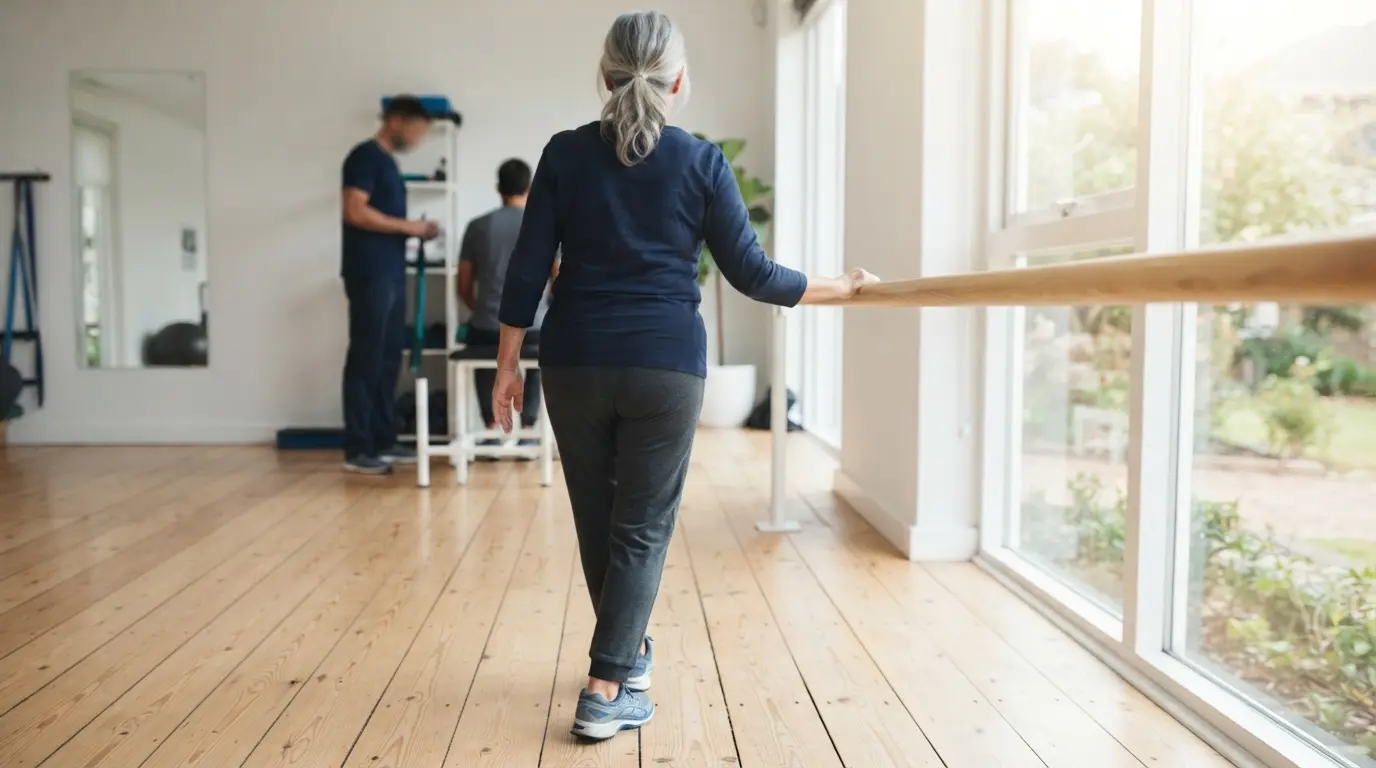
Set up your exercise area in a clear room corner before you start. Working inside a corner puts solid plaster walls on both sides of your shoulders, giving you an immediate barrier if you lean too far.
Work alongside a heavy kitchen bench or a fixed dining table. Never hold onto light chairs, tables on castors, or towel rails that can pull out of the wall. Put on flat, supportive walking shoes with rubber soles rather than walking in smooth socks or loose slippers.
Pick up loose floor rugs, tuck away power cords, and make sure the room has bright lighting. Stop right away if you feel dizzy, short of breath, or experience pain in your chest.
6 Foundational Balance Exercises for Seniors
These beginner drills follow the progression rules used in the Otago Exercise Programme. Keep your movements slow, stand tall, and breathe normally through each repetition.
1. The Single-Leg Stance
Stand with feet hip-width apart beside your kitchen bench.
Rest both hands lightly on the flat surface.
Shift your weight onto your left leg and lift your right foot two inches off the floor.
Keep your standing knee slightly bent rather than locked back.
Hold for 20 to 30 seconds, put the foot down, and repeat on the other side.
2. Heel-to-Toe Tandem Walk
Stand at one end of your bench with one hand resting on top.
Look straight ahead at eye level instead of looking down at your toes.
Place your right heel directly against the front of your left toes.
Step your left foot forward so its heel touches your right toes.
Walk forward like this for 10 to 15 paces, turn around slowly, and return.
3. Sit-to-Stand Transitions
Sit on the front half of a firm dining chair with feet flat on the floor.
Lean your chest forward over your knees.
Push down through your heels to stand up without using your hands if you can.
Stand fully upright for two seconds.
Push your hips back and lower yourself down into the seat under control for 8 to 10 reps.
4. Weight Shifts
Stand tall with feet shoulder-width apart and hands resting on the bench.
Shift your weight slowly onto your right foot until your left foot carries no weight.
Hold that position for three seconds while feeling your right hip work.
Slide your weight smoothly over to your left foot and hold for three seconds.
Complete 10 slow shifts to each side.
5. Calf and Toe Raises
Face your counter with both hands on the surface and feet hip-width apart.
Push through the balls of your feet to lift both heels as high as comfortable.
Hold for two seconds at the top, then lower your heels to the floor.
Rock your weight onto your heels to lift your toes off the ground for two seconds.
Complete 10 full cycles to build ankle strength for tripping clearance.
6. Side Leg Raises
Stand tall behind your bench with your toes pointing straight forward.
Keep your left knee soft and shift your weight to your left side.
Lift your right leg out to the side without tilting your torso.
Hold the leg up for one second, then lower it smoothly to the floor.
Complete 10 lifts with your right leg, then repeat with your left leg.
Seated Stability Exercises for Limited Mobility
You can build valuable core and hip control from an armchair if standing exercises feel unsafe today. A steady trunk gives your legs a firm base to move from when you do stand up. Use a sturdy chair without wheels so your seat stays completely still.
Seated marching trains the hip flexors that lift your feet over steps and curbs. Sit tall, lift your right knee a few inches off the cushion, pause, and place it down. Alternate legs for 20 smooth lifts.
Seated weight shifts teach your body how to manage changes in pelvic pressure. Sit upright with arms crossed over your chest, lean your upper body toward your right hip for two seconds, return to centre, and lean left.
Gentle Vestibular Training in a Chair
Fix your eyes on a picture or light switch straight ahead of you.
Keep your eyes focused on that single point while slowly turning your head to the right.
Turn your head slowly back across to the left, keeping your gaze locked in place.
Complete 10 slow turns to challenge your inner ear without any fall risk.
How to Progress Your Balance Safely
Your body gets used to movements as your muscles and joints grow stronger. To keep improving, you need to make each drill slightly harder over time. The Otago model progresses movements through clear physical steps instead of guessing.
Reduce hand contact first. Start with a firm grip with two hands, move to resting one hand on the bench, and then use just two fingertips. Once your feet stay planted without wobble, hover your hands two inches above the bench so support is right there if you need it.
Narrow your stance next. Move from a wide foot position to standing with your feet touching side by side. From there, try a semi-tandem stance with one foot half a step ahead before trying a full tandem line.
Clinical trials reviewed by the National Center for Biotechnology Information (NCBI) show that structured balance routines reduce fall-related injuries by 35%. Other gentle movement practices work well too. Research published in the Cochrane Database of Systematic Reviews found that regular Tai Chi routines cut fall rates by up to 43% by teaching continuous, controlled weight shifts.
Building a Consistent Weekly Routine
Consistency is what creates lasting stability. Plan to do your balance exercises for seniors three days each week, taking rest days in between so your legs recover. A typical session takes about 20 minutes.
Add 30 minutes of walking on two or three other days of the week. Walking gets your heart working and keeps your knee and hip joints moving freely.
You can also weave quick drills into your regular day. Stand on one leg while waiting for the kettle to boil, or complete three controlled chair stands before sitting down for lunch.
Professional Allied Health Support
Home balance training works well for healthy routines, but frequent trips, joint pain, or dizzy spells need clinical attention. An Accredited Exercise Physiologist can run mobility tests like the Timed Up and Go (TUG) assessment to pinpoint where your balance is breaking down.
Our clinicians work with older adults through targeted aged care exercise physiology and fall prevention programs. We treat clients in our Castle Hill and Westmead clinics. We check joint movement, screen your walking patterns, and build exercise plans around your personal goals.
You can fund these visits in several ways. Ask your GP if you qualify for a Chronic Disease Management plan, which provides Medicare rebates for up to five allied health visits each year. We also provide services for self-managed and plan-managed participants who have NDIS exercise physiology supports in their plans, and we accept private health insurance.
Frequently Asked Questions
How often should an older adult practice balance exercises?
Three practice sessions a week give your nerves and muscles plenty of stimulation. Keeping each session to 20 or 30 minutes prevents excessive leg fatigue while building strength.
What should I do if I feel dizzy while exercising?
Stop immediately and sit down in a firm chair with armrests. Drink some water and rest until your head clears completely. Check in with your GP or exercise physiologist before you try that movement again.
Can balance exercises really reverse age-related muscle loss?
Regular resistance and balance drills wake up underused muscle fibres at any age. Consistent weekly practice strengthens the stabilising muscles around your ankles, knees, and hips.
Take the Next Step for Your Mobility
Do not wait for a stumble to start working on your stability. Contact our team to book your comprehensive clinical balance assessment.