

How to Access Occupational Therapy Through Your NDIS Plan
Most NDIS participants pay for occupational therapy from the Capacity Building, Improved Daily Living budget in their plan. Knowing which category covers your appointments, how provider travel is billed, and when to request reports keeps your funding on track. You do not need a GP referral to book an occupational therapy NDIS assessment, and sessions run at home, via telehealth, or in a clinic across Western Sydney.
Key Takeaways
Assessment, therapy, and report writing sit under Capacity Building, Improved Daily Living (Category 15), capped at $193.99 per hour on weekdays under 2026–27 pricing rules.
Plan-managed and self-managed participants can book any AHPRA-registered therapist, while NDIA-managed plans require an NDIS-registered provider.
Everyday equipment under $1,500 uses Core Consumables, whereas mid-cost aids, high-cost technology, and home modifications require Capital Supports and formal clinical reports.
Booking a Functional Capacity Assessment or progress report 6 to 8 weeks before your plan reassessment gives planners clear evidence for your next budget.
Which NDIS Budget Pays for Occupational Therapy?
Your NDIS plan splits funding into Core, Capacity Building, and Capital Supports, and occupational therapy NDIS services sit inside Capacity Building. Within that category, Improved Daily Living (Category 15) pays for clinical assessments, ongoing therapy sessions, carer training, and formal report writing. Under NDIS therapy support guidelines, this budget covers both building new daily skills and maintaining current function in progressive conditions, plus training family members or support workers to use equipment safely.
Once you confirm that your plan includes Improved Daily Living funds, your plan management style controls which providers you can book. Data from the NDIA Quarterly Reports shows that roughly 7 in 10 participants use a plan manager, 25% are fully or partly self-managed, and 6% are NDIA-managed. Each pathway has different rules:
Plan-Managed: You can book any qualified, AHPRA-registered therapist, whether the clinic is NDIS-registered or not, and your plan manager pays the invoices.
Self-Managed: You can choose any registered or unregistered qualified therapist, pay invoices directly, and claim reimbursement through your myplace portal without being bound by standard price caps.
NDIA-Managed (Agency-Managed): You must choose an NDIS-registered provider who claims payments directly from the National Disability Insurance Agency.
Under the NDIS Pricing Arrangements and Price Limits, standard weekday occupational therapy is capped at $193.99 per hour for agency-managed and plan-managed participants. From 1 July 2026, updated pricing rules require providers to unbundle report writing, non-face-to-face clinical tasks, and provider travel into separate line items, with travel time capped at 50% of the standard hourly rate (up to $97.00 per hour on weekdays). Because a full 10-hour initial assessment uses nearly $2,000 of your annual allocation, many of our local clients in Castle Hill and Westmead coordinate their schedule early when sharing this same budget across speech pathology, psychology, and NDIS exercise physiology.
What Happens in an OT Assessment?
After confirming your budget and provider pathway, your first appointment is an initial occupational therapy NDIS assessment. During this session, your therapist measures how your disability affects everyday tasks rather than simply listing a medical diagnosis. While a physiotherapist focuses mainly on joint strength, muscle recovery, and physical movement, an occupational therapist looks at practical independence at home, school, work, and in the community.
Every therapist on our team is an AHPRA-registered health practitioner, which is a mandatory NDIA requirement for delivering allied health supports. Using evidence-based clinical assessments, we evaluate four connected areas of your daily routine during this first visit:
Daily Living Skills: We observe how you manage showering, dressing, meal preparation, household cleaning, and fatigue pacing across a typical week.
Sensory Processing and Routines: For neurodivergent children and adults, we assess sensory triggers, emotional regulation strategies, and morning or evening routines that reduce daily overwhelm.
Physical Environment and Safety: We check bathroom transfers, kitchen bench heights, stairs, and lighting to spot fall hazards or physical barriers inside your home.
Community and School Participation: We assess fine motor skills, handwriting, budgeting, transport access, and social confidence in real-world settings.
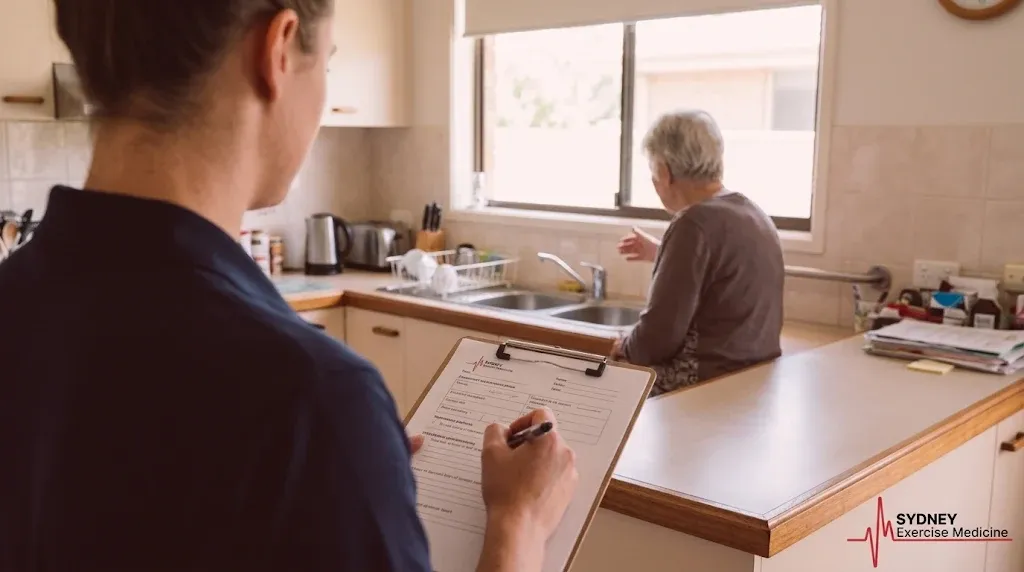
Where we conduct this evaluation depends on your goals. Visiting your home in suburbs like Baulkham Hills, Parramatta, or Merrylands lets us see how you actually get in and out of your own shower or cook at your kitchen bench. When home access is not needed, clinic sessions at our Castle Hill or Westmead facilities give you access to purpose-built gym and therapy equipment, while telehealth works well for routine check-ins and parent coaching.
Functional Capacity Assessments and Reports
Everything we observe during your initial sessions feeds into your clinical documentation, particularly if you need a Functional Capacity Assessment (FCA). An FCA is a detailed clinical evaluation that documents your strengths, daily barriers, and support needs for the NDIA. When you apply for plan funding adjustments, Supported Independent Living (SIL), or Specialist Disability Accommodation (SDA), planners rely on this report to decide which supports are reasonable and necessary.
Most FCAs involve 1 to 3 hours of face-to-face observation and testing, followed by 4 to 10 hours of clinical analysis and report writing. NDIA planners routinely reject reports that rely on a medical diagnosis without proving day-to-day functional impact, so strong reports meet four clear evidence standards:
Objective Baseline Metrics: We record concrete numbers, including transfer times, falls frequency, fatigue recovery periods, and current paid support hours.
Clear Functional Linkage: Every recommendation shows how a support directly addresses an impairment, enables a specific daily task, and builds independent living skills.
Value for Money: Reports demonstrate cost-effectiveness over time, such as showing how targeted therapy or equipment reduces reliance on ongoing support workers.
Exclusion of Cheaper Options: Your therapist explains why standard household items or lower-cost alternatives will not safely meet your disability-related needs.
Booking a progress report 6 to 8 weeks before your NDIS plan reassessment gives your therapist enough time to measure goal outcomes and submit updated clinical evidence before your review meeting takes place.
Assistive Technology and Home Modifications
Alongside recommendations for ongoing therapy hours, your OT assessment often identifies equipment or home changes that make daily routines safer. While your Improved Daily Living budget pays for your therapist's assessment, trial, and prescription time, the physical items and building works themselves are funded separately through your Core – Consumables budget or your Capital Supports budget.
Under NDIS assistive technology guidelines, equipment falls into three price tiers:
Low-Cost Assistive Technology (Under $1,500 per item): Everyday aids like shower chairs, non-slip mats, lever tap turners, and adaptive cutlery come from your Core Consumables budget and do not require quotes or prior NDIA approval.
Mid-Cost Assistive Technology ($1,500 to $15,000 per item): Equipment such as mobile hoists, pressure-care mattresses, and custom-fitted seating sits in Capital Supports and requires written clinical justification from an OT, as outlined in the NDIA mid-cost and high-cost assistive technology rules.
High-Cost Assistive Technology (Over $15,000 per item): Complex power wheelchairs, smart home automation, and communication devices require a formal assistive technology assessment report, 1 to 4 weeks of documented equipment trials, and itemised supplier quotes.
When simple aids are not enough to make your living space accessible, your therapist can also assess your property under the NDIS home modifications framework. Minor home modifications cost under $25,000 and cover non-structural changes like threshold ramps, handheld shower hoses, and grab rails. Complex home modifications cost over $25,000 or involve structural, plumbing, or electrical work, requiring building permits, two itemised quotes, and written permission from your landlord if you live in a rental property.
How to Book
Once you know which budget covers your needs and what type of assessment you require, setting up your first appointment takes four straightforward steps:
Check Your Plan Details: Confirm that your plan includes Capacity Building, Improved Daily Living funding and verify your management type (our clinic welcomes self-managed and plan-managed NDIS participants; please check with our team regarding NDIA-managed eligibility).
Gather Helpful Background Notes: Sharing your current NDIS plan goals, previous allied health reports, or medical summaries helps us prepare, though no doctor's referral is needed.
Review Your Service Agreement: Following the October 2026 NDIA service agreement resources, we provide a clear written agreement outlining session rates, unbundled report fees, travel charges, and cancellation policies before therapy begins.
Schedule Your First Session: Choose an in-home visit across Western Sydney, a telehealth consultation, or an in-clinic appointment when you contact our Castle Hill or Westmead clinics.
If your plan includes therapy supports, our NDIS occupational therapy team can start with an assessment at home or in the clinic.
Frequently Asked Questions
Do I need a GP referral to access NDIS occupational therapy?
No, you do not need a GP or specialist referral to book an occupational therapy appointment under your NDIS plan. You can reach out to our clinic directly, or ask your support coordinator, plan manager, or family member to submit a referral on your behalf.
Can I use my NDIS funding for both occupational therapy and exercise physiology?
Yes, you can split your Capacity Building, Improved Daily Living budget across multiple allied health therapies where the supports align with your plan goals. Many participants combine occupational therapy for daily living skills and home safety with exercise physiology for strength, balance, and mobility.
How long does an NDIS Functional Capacity Assessment report take?
A standard Functional Capacity Assessment involves 1 to 3 hours of face-to-face evaluation, followed by 2 to 4 weeks for your therapist to complete clinical analysis and finalise the report. Booking at least 6 to 8 weeks before your plan reassessment ensures your report is ready on time.
Does the NDIS pay for occupational therapist travel to my home?
Provider travel can be claimed from your Improved Daily Living budget when agreed in advance under your service agreement and within NDIA travel rules. Under the 2026–27 NDIS pricing arrangements, provider travel time is listed separately and capped at 50% of the standard hourly therapy rate.
Ready to Build Practical Independence at Home or in the Clinic?
Speak with our Western Sydney allied health team to check appointment availability in Castle Hill, Westmead, or your local home environment.